Disaster and Crisis Contracting, Parts I and II
DETAILED DESCRIPTIONS:
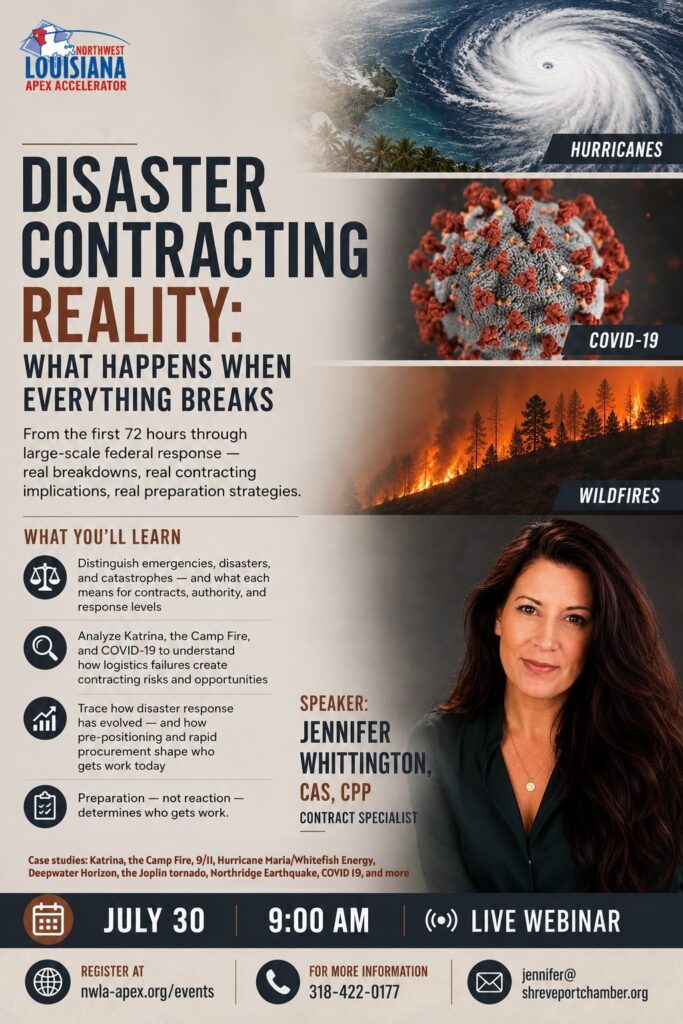
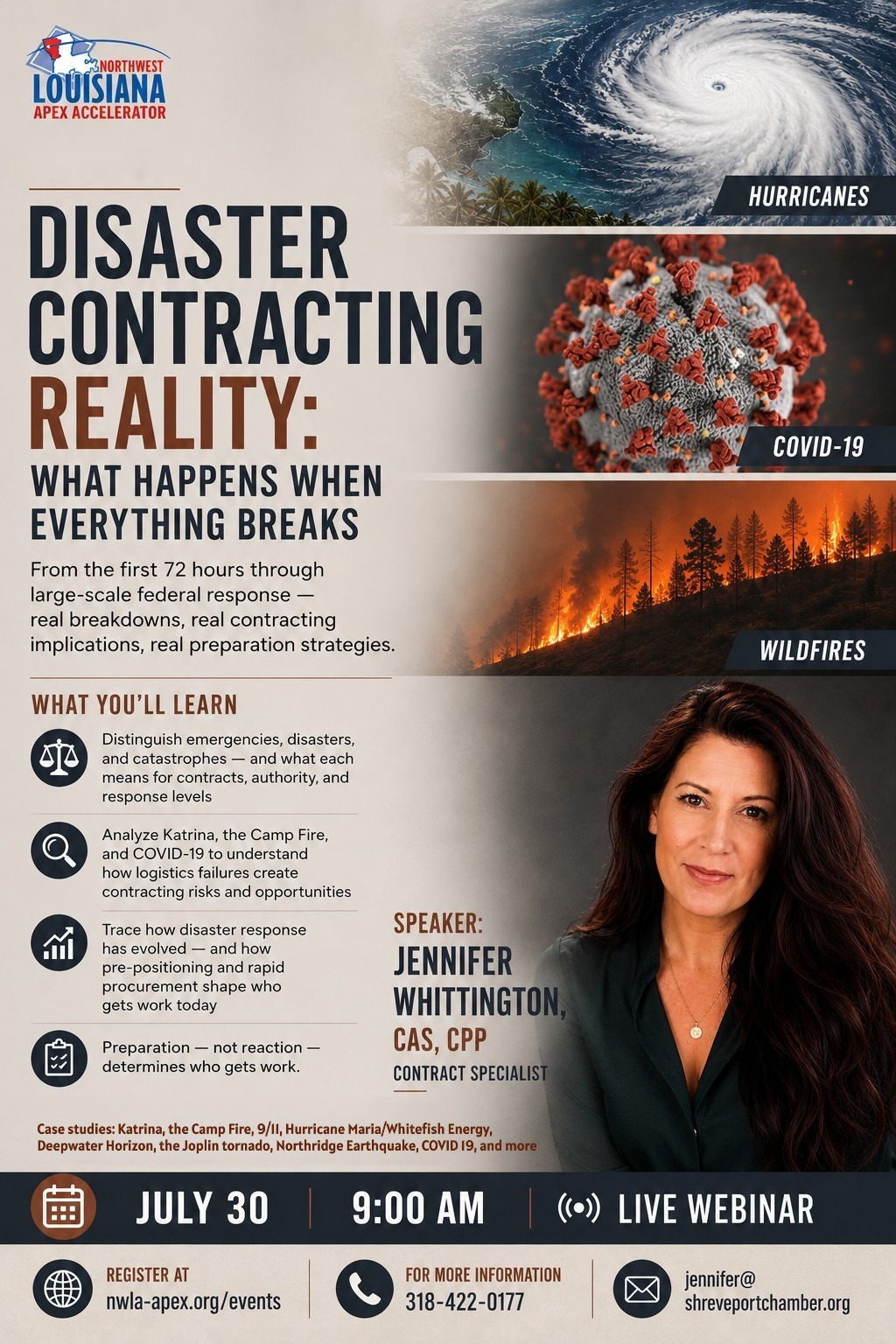
9:00 am Disaster Contracting Reality: What Happens When Everything Breaks (Part I)
This session breaks down what really happens during disasters—from the first 72 hours through large-scale federal response. Participants will explore how failures like Hurricane Katrina, the Camp Fire, and the COVID-19 pandemic reshaped government systems, and how modern disaster response has evolved into a structured—but still high-risk—contracting environment.
Rather than focusing on theory, this session examines real-world breakdowns, response challenges, and recovery successes to show how contracting demand is created, where systems fail, and why preparation—not reaction—determines who gets work.
Participants will leave with a clearer understanding of disaster environments as contracting systems, and how to interpret those conditions.
By the end of this session, participants will be able to:
-
Differentiate between emergency, disaster, and catastrophe events and explain how each impacts contracting opportunities, who’s in charge, and government response levels.
-
Analyze major disaster failures and identify the contracting implications, including how breakdowns in logistics, oversight, and coordination create both risks and opportunities.
-
Explain how disaster response systems have evolved over time and how those changes influence modern contracting practices, including pre-positioning and rapid procurement.
10:00 am From Chaos to Contracts: Disaster Contracting Strategy (Part 2)
This session focuses on how contractors actually enter and compete in disaster contracting. Participants will learn the full procurement landscape—from local emergency purchasing to federal contracting pathways—including lesser-known key systems such as FEMA’s Tender of Service Program, the “secret” U.S. Army Corps of Engineers vendor databases, GSA’s “Disaster Aisle” and subcontracting strategies.
The session also covers emergency acquisition rules within the FAR overhaul, compliance risks, common contractor failures, and real-world decision-making scenarios to prepare for the realities of disaster contracting before, during, and after an event. Using examples such as Hurricane Maria and the Whitefish Energy contract, the Northridge Earthquake, the Deepwater Horizon oil spill, along with other case studies, participants will examine how contract decisions and vendor positioning impact outcomes in disaster environments.
By the end of this session, participants will be able to:
-
Identify the primary pathways to entering disaster contracting, including local, state, and federal procurement systems, required registrations, and evolving purchasing methods.
-
Apply key emergency acquisition rules and thresholds (FAR Part 18, FAR Part 13, local preference, and documentation requirements) to real-world contracting scenarios.
-
Develop a practical strategy to pursue disaster contracting opportunities, including subcontracting approaches, relationship-building, and pre-disaster positioning.